
Most SEO trend posts are written in November, predicting a year nobody has lived in yet. I am writing this one in June 2026, halfway through the year, after testing this stuff on real sites the whole time, including this one.
So instead of twelve buzzwords, here is what actually changed, how the loud 2025 predictions held up once the data came in, and what I would do right now if I were starting over.
Here are the four numbers that frame the year.
First, a hype check: the 2025 predictions, graded
The SEO world made a lot of confident calls for 2025, and almost nobody goes back to check them against what actually happened. So that is where I want to start, before any new trends. Here is how the loudest predictions held up once the numbers came in.
“AI Overviews would gut organic clicks.”
This one held up. When an AI Overview shows up, the click rate on an organic result falls about 61%, and roughly 68% of Google searches now end with no click at all.
“ChatGPT would replace Google as how people search.”
Overblown. Google still sends the large majority of referral traffic, and every AI assistant combined is only a low-single-digit share. The channel is growing, not winning.
“Every site needs an llms.txt or it disappears from AI.”
Also overblown. One study watched 500 million AI-bot visits and counted 408 fetches of llms.txt. Adoption sits near 7-10% and the big engines mostly ignore it. Worth publishing as cheap insurance, not as a strategy.
“Core updates would keep punishing thin, templated content.”
Held up, and then some. The March 2026 core update ran even hotter than December, reshuffling about 80% of the top-3 results across tracked queries. The sites built on volume over substance took the hit.
“Getting cited in an AI Overview would matter more than ranking #1.”
Held up. Brands cited inside an AI Overview earn around 120% more organic clicks per impression than uncited brands on the same query. The citation is the new position one, and most teams still do not measure it.
“AI Mode is a Labs experiment, not the main event yet.”
This is the call the consensus underestimated. AI Mode passed a billion users inside a year, and at I/O 2026 Google made it the default Search experience on a new Gemini model. It arrived far faster than the room expected.
Three of those calls held up, two were overhyped, and one badly underestimated what was coming. That last one is the interesting one, so I will come back to it.
Now the trends themselves.
1. The AI Overview is the search result now
There is nothing left to predict here. An AI Overview now shows up on roughly half of Google searches1, and on those searches the click rate on an organic result drops by around 61%2. Step back and roughly 68% of all Google searches now end without a single click3.
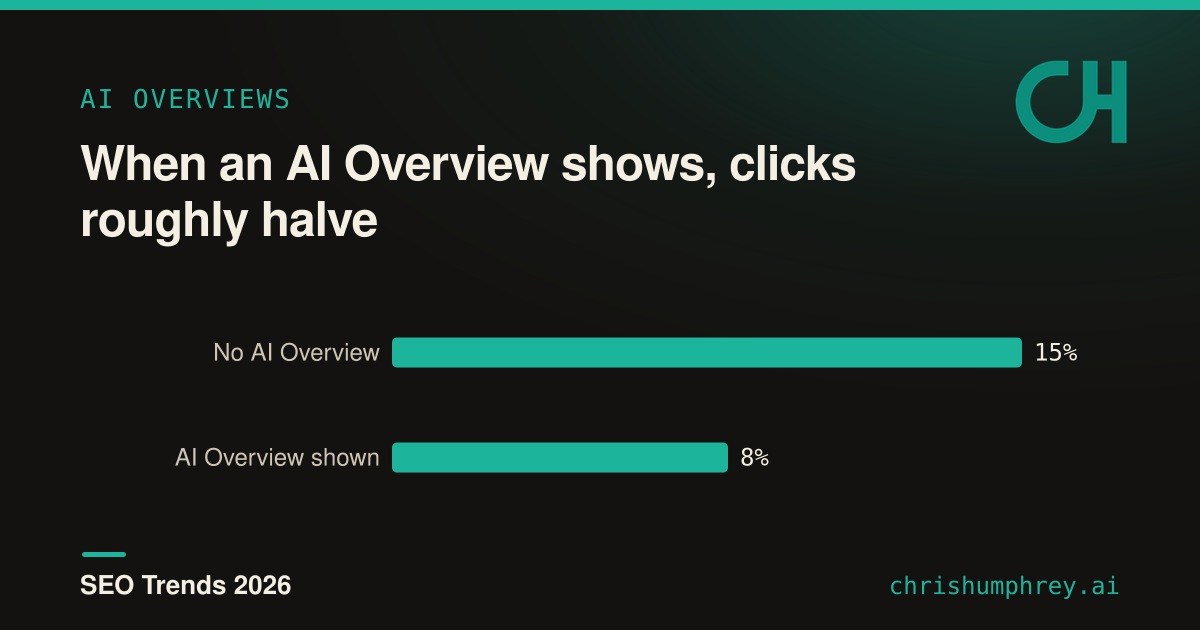
Most coverage stops at that drop, which is the less useful half of the story. The brands quoted inside the Overview earn roughly 120% more clicks per impression than the ones ranking on the same page who never get named2, so the clicks that still happen pile up around whoever the Overview chose to cite.
That resets what you are optimizing for. Ranking still matters, but it has turned into the price of being in the running rather than the thing that wins the click, and the click goes to whoever the answer names. I wrote up the formatting that earns those citations in AI Overviews vs classic SEO.
2. AI Mode went from experiment to default
This is the call the consensus underestimated. A year ago the common read was that AI Mode was a Labs experiment that would take its time to matter, and instead it went from experiment to the default Search experience inside a single year. It passed a billion users along the way, and at I/O 2026 Google made the AI-first version the default, running on a new Gemini model.4
The ten blue links have not gone anywhere, and Google’s VP of Search has been clear about that. What changed is the default. For a growing share of searches the first thing a person meets is a back-and-forth instead of a page of links, and they tend to ask longer, messier questions and keep following up inside the same session. That quietly breaks the old one-keyword-one-page model, because a single AI Mode session can wander across six topics without ever loading a results page your analytics can see.
If your reporting still treats a ranking position as the finish line, it is measuring something that increasingly happens where it cannot see. I break down what AI Mode going default actually changes in how Google Search itself is trending.
3. Citation beat ranking, and most teams still do not measure it
Put the first two trends together and you get the real shift of 2026: ranking and visibility have come apart. You can hold a top spot and still be invisible inside the answer, or get cited without ranking anywhere near the top. What earns the click now is your name turning up in the synthesized response, more or less regardless of where you sit in the list underneath it.
I sat on a panel about exactly this a few weeks ago, and the line that stuck with me came from the PR side of the room: AI works out what to say about you by leaning on the parts of your story that agree across the whole web, your own site and the review platforms and the press and whatever your people say in public. That consistency now counts for more than any single page you control. The full panel notes are here if you want them.
In practice that means widening what you report on. Rank by itself is no longer enough, so you also want to track whether you show up in the answer at all and whether it gets you right. I built a free AI content visibility checker to make that less of a guessing game.
4. The “AI search replaced Google” story stayed hype
This is the one where the headlines ran a long way ahead of the numbers. AI assistants are growing fast and the traffic they send converts well, but they are still a small slice of how people actually reach websites. Google still sends the large majority of referral traffic, and every AI assistant combined is only a low-single-digit share of it.5
The more interesting movement is inside that small slice.
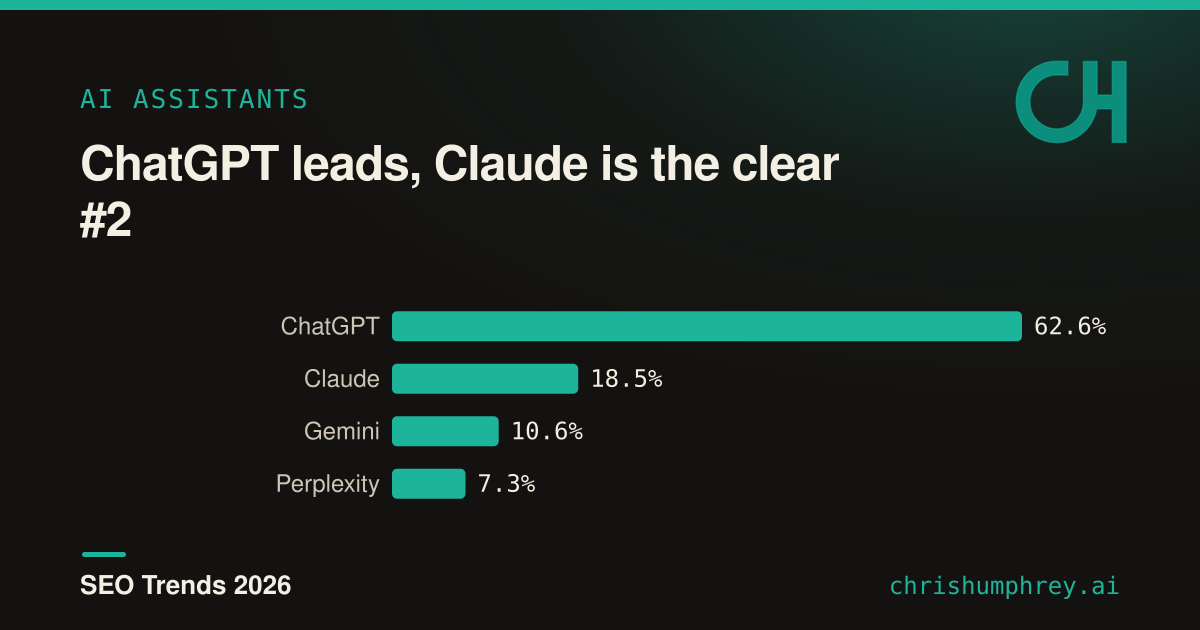
Claude overtook Gemini and Perplexity to become the #2 source of AI referrals6, which almost nobody saw coming a year ago. The accurate read is an unglamorous one. A new, small, high-intent channel is forming, and the pecking order inside it is still being settled, so it is worth building for at the size it actually is rather than the size that would justify pulling budget off Google. I unpack why the takeover narrative keeps getting recycled in the one SEO trend everyone got wrong in 2025.
5. Core updates kept rewarding depth and punishing filler
The March 2026 core update ran even hotter than December’s, reshuffling about 80% of the top-three results across tracked queries7. Once it settled, the pattern was the same one that has been building for three years: thin, templated, made-for-search pages slid down, while pages with first-hand experience, a real point of view, and visible trust signals mostly held on or climbed.
None of this is new advice. It is the advice it has been for years, with higher stakes attached, because AI answers pull from the pages Google already trusts. Do the classic SEO work well and the AI citation tends to come out of the same effort. I traced how we got here in how SEO actually changed from 2023 to 2026.
6. The trends I am ignoring on purpose
Not everything that trends is worth your time, and llms.txt is the clearest example this year. The 2025 pitch was that you needed one or you would vanish from AI, and then someone watched 500 million AI-bot visits and counted all of 408 fetches of the file8. Adoption sits near 7 to 10%, and the engines that matter mostly ignore it.
I still publish one, since it takes a few minutes and it is cheap insurance if the standard ever catches on. What I will not do is treat it as a strategy or let it crowd out work that actually moves rankings. The data behind that call is in my llms.txt research, and the plain-English version is the llms.txt guide. The full list of what I am skipping this year, with the reasons, is in the SEO trends I am ignoring in 2026.
What I would actually do right now
Enough about trends in the abstract. Here is the short list I am actually running on my own sites this year.
- Write for the citation. Lead every page with a tight, quotable answer in the first 60 words, lean on question-shaped headings, and add a comparison table where one fits. Give an engine an easy sentence to lift and it will lift yours instead of a competitor’s.
- Keep your signals honest. Decide your posture on AI crawlers once and make
robots.txtagree with it. You can check what you currently allow or block with my free AI crawler checker. - Measure visibility, not only position. Track whether you appear in AI answers and whether they get you right, because rank alone now hides as much as it reveals.
- Refresh your cornerstone pages. AI engines weigh recency, so a strong 2024 page with no updates loses ground to a 2026 page on the same topic. This one is a page I will keep updating all year.
- Build trust off your own site. Reviews, the press, and consistent public statements all feed the answer, which gets assembled from everywhere you show up and not only the pages you control.
That is the year so far. The surface of search keeps moving quickly while the things that actually win underneath it have barely shifted, which is the part I keep coming back to. What still wins is a genuinely useful page, written so a person or a model can get through it without straining, from a source that holds up when someone goes looking into you.
If you want to get better at telling the real shifts from the noise before next year’s predictions land, start with how to spot a real SEO trend. Once you can run that check yourself, posts like this one become optional reading instead of required.
Go deeper: the full 2026 cluster
Each trend above has a full write-up. Here is the whole set in one place.
Frequently asked questions
What are the biggest SEO trends in 2026?
The defining shift is that AI Overviews and AI Mode turned search into answers. Around half of Google searches show an AI Overview, getting cited in that answer now matters more than ranking first, and Google made AI Mode the default experience at I/O 2026. Core updates keep rewarding depth and trust over volume.
Is SEO dead in 2026?
No. Google still sends about 88% of referral traffic, and the pages AI answers cite are usually the ones already ranking well. SEO did not die, it split into two jobs: ranking on the page, and getting named inside the AI answer. You need both.
Do AI Overviews hurt website traffic?
They lower clicks on the average query. When an AI Overview appears, the click rate on an organic result falls about 61%. But brands cited inside the overview earn roughly 120% more clicks per impression than uncited ones, so the traffic concentrates on whoever gets quoted rather than disappearing.
Should I create an llms.txt file in 2026?
Publish one because it is free insurance, but do not treat it as strategy. A study of 500 million AI-bot visits found llms.txt fetched only 408 times, and adoption sits near 7 to 10%. The major engines mostly ignore it today. Spend your real effort on content and trust signals instead.
Is ChatGPT replacing Google search?
Not by the numbers. AI assistants combined send only a low single-digit share of referral traffic, while Google still sends the large majority. AI search is a fast-growing, high-intent channel worth planning for, not a replacement for Google yet.
How do I rank in Google's AI Mode and AI Overviews?
Win classic SEO first, because AI answers pull from pages Google already trusts. Then format for extraction: a quotable answer in the first 60 words, question-shaped headings, comparison tables, and FAQ or HowTo schema. Keep cornerstone pages fresh, and build consistent trust signals across the web.
Sources
-
AI Overviews appeared on roughly 48% of tracked queries by February 2026, up from about 31% a year earlier. BrightEdge, one-year AI Overviews data, 2026. ↩
-
Across 53 brands, 5.47M queries and 2.43 billion organic impressions, organic click-through fell about 61% on AI Overview queries, and brands cited inside the Overview earned about 120% more clicks per impression than uncited ones. Seer Interactive, AIO Impact on CTR: 2026 Update. ↩ ↩2
-
About 68% of US Google searches ended without a click in early 2026, per SparkToro’s analysis of Similarweb clickstream data. Search Engine Land, 2026. ↩
-
Google AI Mode passed one billion monthly users and became the default Search experience on the new Gemini 3.5 Flash model. Google, Search at I/O 2026. ↩
-
AI assistants remain a low-single-digit share of referral traffic, a small fraction of Google’s volume in clickstream data. Similarweb, Gen AI stats 2026. ↩
-
Brand-averaged share of measurable B2B AI referrals, March to April 2026: ChatGPT 62.6%, Claude 18.5%, Gemini 10.6%, Perplexity 7.3%. Goodie, 2026 AI Search Traffic Report. ↩
-
In the March 2026 core update, 79.5% of top-3 URLs changed positions, more volatile than December 2025’s 66.8%. Search Engine Land, 2026. ↩
-
Across more than 500 million AI-bot visits over 90 days, only 408 requests touched llms.txt; a separate SE Ranking study of 300,000 domains found about 10% adoption. Limy, 2026. ↩
Working on this same shift?
I write about SEO, GEO, and getting found by AI search.
If this resonated, I'd love to compare notes.