
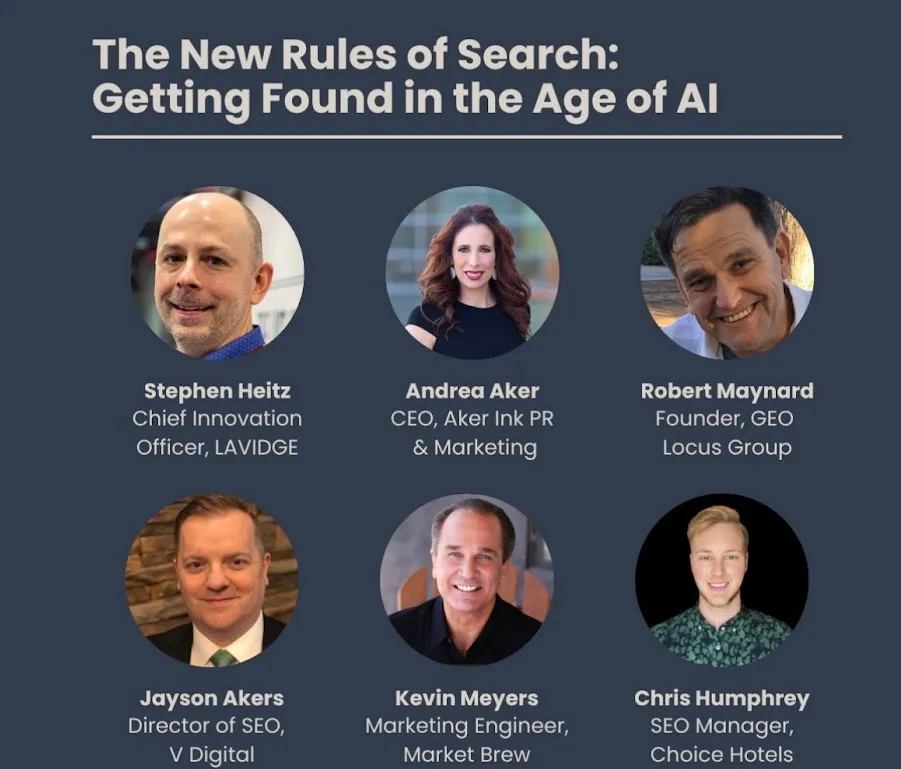
Last month I sat on a six-person panel AZIMA put together called “The New Rules of Search: Getting Found in the Age of AI.” It was an in-person evening, just a moderated conversation about how AI is changing the way people find brands. The room was full of marketers working through the same questions we were.
A lot of why it worked was the mix of people. Stephen Heitz from LAVIDGE moderated, and the rest of us came at the topic from pretty different angles: Andrea Aker from the PR and authority side, Jayson Akers from agency SEO, and Robert Maynard and Kevin Myers from the technology side, both of them building infrastructure around knowledge graphs and retrieval. I was there as the in-house voice. Get that range of people in a row and you cover a lot of ground without everyone just nodding along, which is sort of the point of putting a panel together in the first place.
Rather than recap the whole night, I wanted to write down a few of the ideas that have stayed with me since.
One that came up early was the gap between ranking and visibility. We’re all used to thinking in terms of position, where you land in a list of results. But a lot of AI search doesn’t produce a list. You get a single synthesized answer, so the question becomes whether you show up in that answer and whether it represents you accurately. Chasing that turns out to be a pretty different exercise than chasing the top spot, and it changes what you pay attention to and what you end up measuring.
A good deal of the conversation kept circling back to authority and trust. Andrea made the case, better than I could have, that PR and credibility are becoming part of search infrastructure rather than a separate discipline sitting off to the side. When an AI decides what to say about a company, it pulls from everywhere that company shows up and leans on the parts of the picture that agree with each other. So the consistency of your story across the web, whether that’s your own site, the review platforms, the press, or what your executives say publicly, ends up carrying more weight than any single page you happen to control. Andrea wrote up her own recap of the night as well, and it’s worth a read.
The measurement side is the part I’ve got the strongest feelings about, mostly because it’s what I work on day to day. As more answers get handled right there on the results page, the click into your own site happens less often, particularly early in someone’s research. When you watch sessions fall, it’s tempting to read that as demand drying up, even though the demand has usually just moved upstream into a part of the journey our older dashboards were never built to see clearly. Working out how to report on that honestly, without panicking and without pretending nothing has changed, is something most teams are still in the middle of. Mine very much included.
We finished on a lightning round, and mine was whether people two years from now will book a hotel through a regular search or through some kind of personal AI assistant. I said the assistant, with the honest caveat that I’d still want to look the place over myself before trusting it with the reservation. I suspect most people would feel the same way, which is roughly where the whole subject seems to land. The tools are going to get very good at the legwork, and we’re all still going to want a reason to trust what they hand back.
None of this felt like search being replaced so much as search changing shape while the thing underneath it stayed put. You still have to be easy to find and worth trusting when someone, or something, goes looking into you. It was a sharp group to think all of this through with, and I walked out with a longer list of things I want to test than I came in carrying.
Thanks to AZIMA for putting it on, and to the rest of the panel for a genuinely good conversation.
Working on this same shift?
I write about SEO, GEO, and getting found by AI search.
If this resonated, I'd love to compare notes.