
Measurement
The Largest Search Engine in the World in 2026, and Where ChatGPT Fits
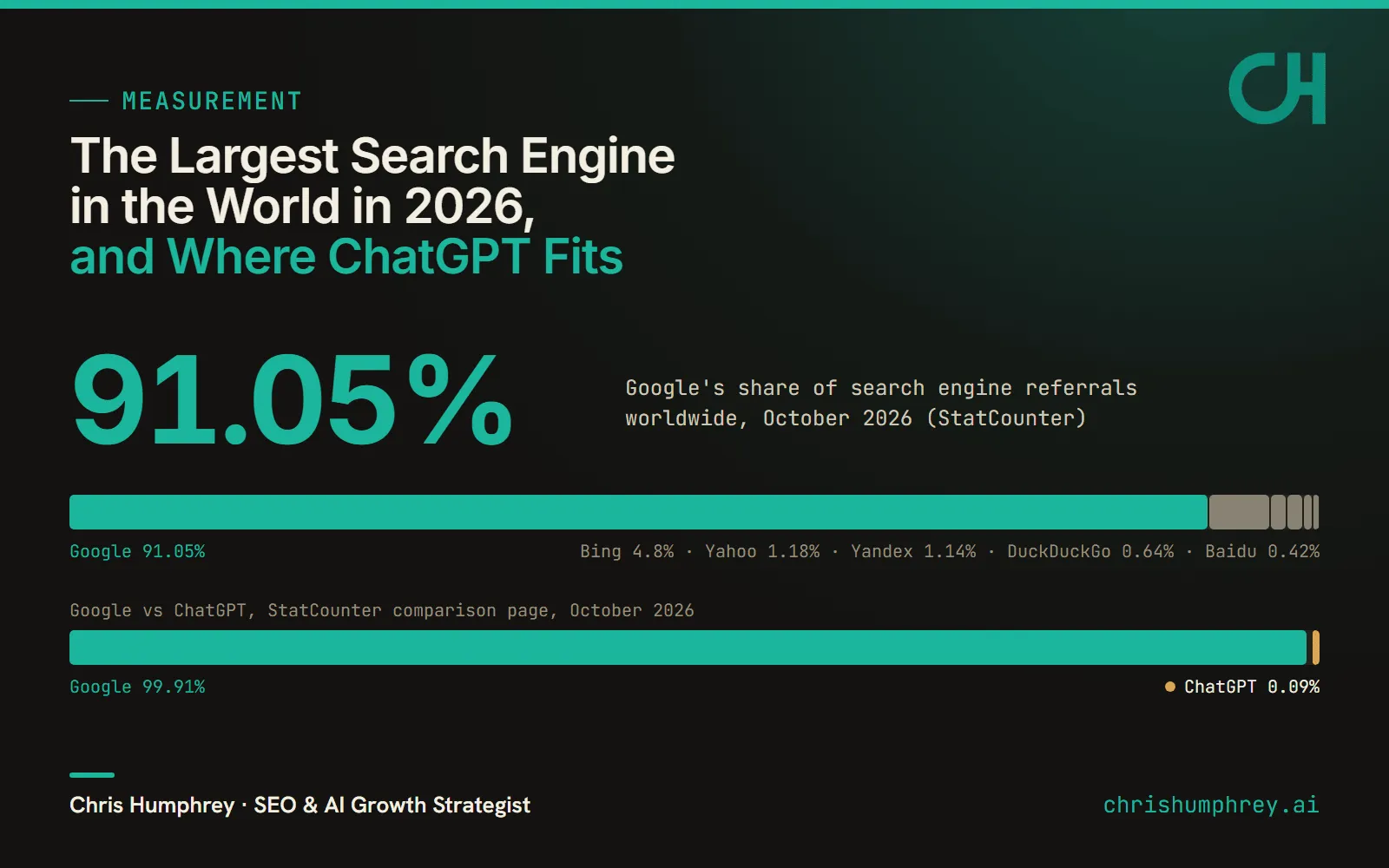
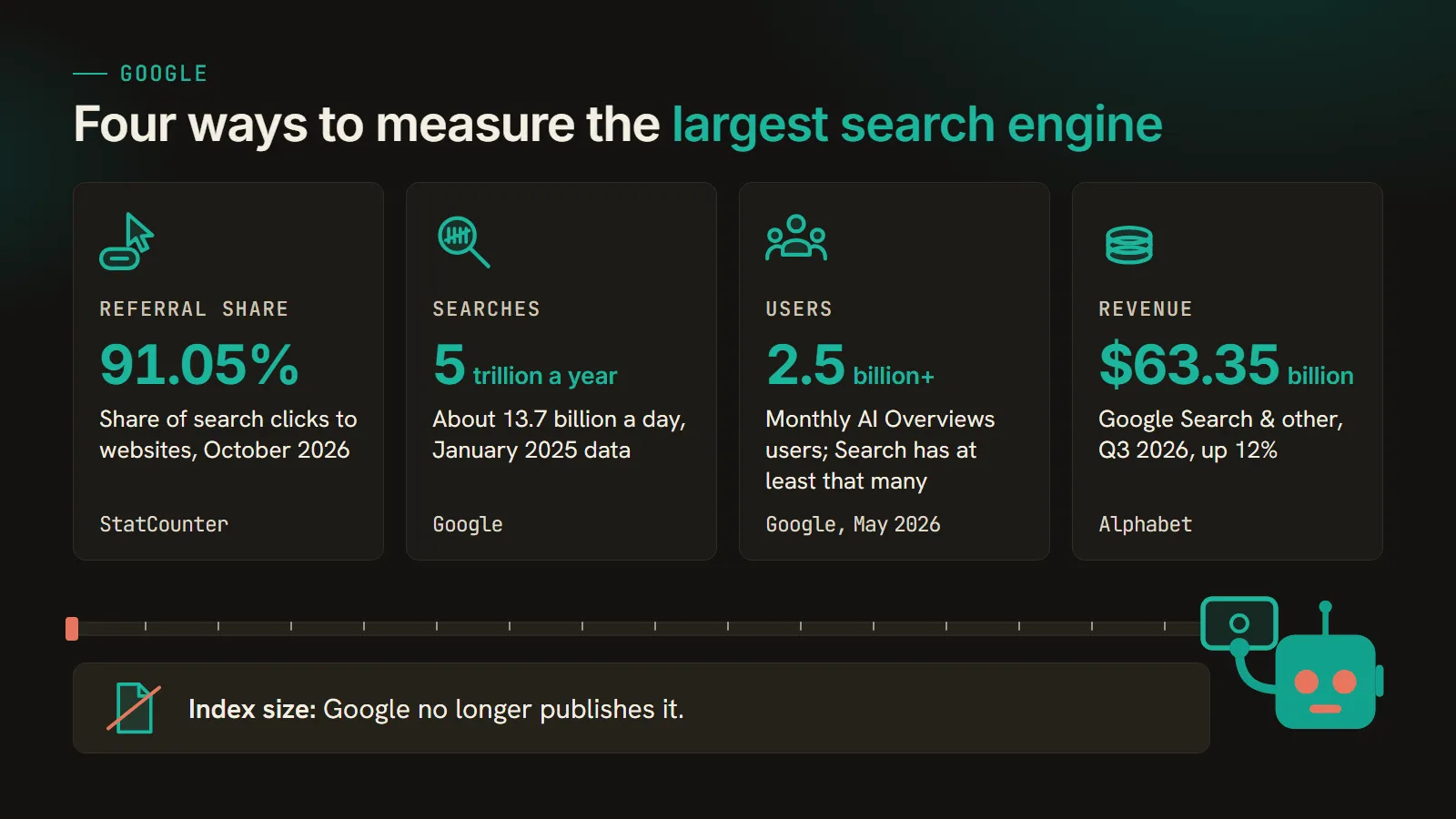
Google is the largest search engine in the world. In October 2026 it accounted for 91.05% of all search engine referrals worldwide, according to StatCounter, and Bing was a distant second at 4.8%.1 If you run a website, that means Google is where nearly all your search traffic comes from, and Bing is the second one to bother with, mostly for desktop and US visitors.
Which one is “largest” depends on what you count, and that 91.05% only counts clicks through to websites, so I’ve also pulled Google’s own search counts, user numbers and revenue. On November 6 I asked six AI answer engines the same question to see what they’d say. I don’t sell a search engine or anything that ranks them, and there are no affiliate links in this post.
What is the largest search engine in the world?
StatCounter’s full October 2026 list has Google at 91.05%, then Bing (4.8%), Yahoo (1.18%), Yandex (1.14%), DuckDuckGo (0.64%) and Baidu (0.42%).1 The revenue and user figures further down come from the companies’ own filings (Alphabet owns Google, and Baidu, Inc. files with the SEC).23
Most of the ranking pages I read describe market share as a share of all searches. StatCounter, which produces the number those pages quote, says its figures are “based on what we call search engine referrals, not the number of searches performed.”4 A referral is a visit that lands on a website after someone clicks a search result, and StatCounter counts those on the sites that carry its tracking code, which it says is installed on more than 1 million sites.4
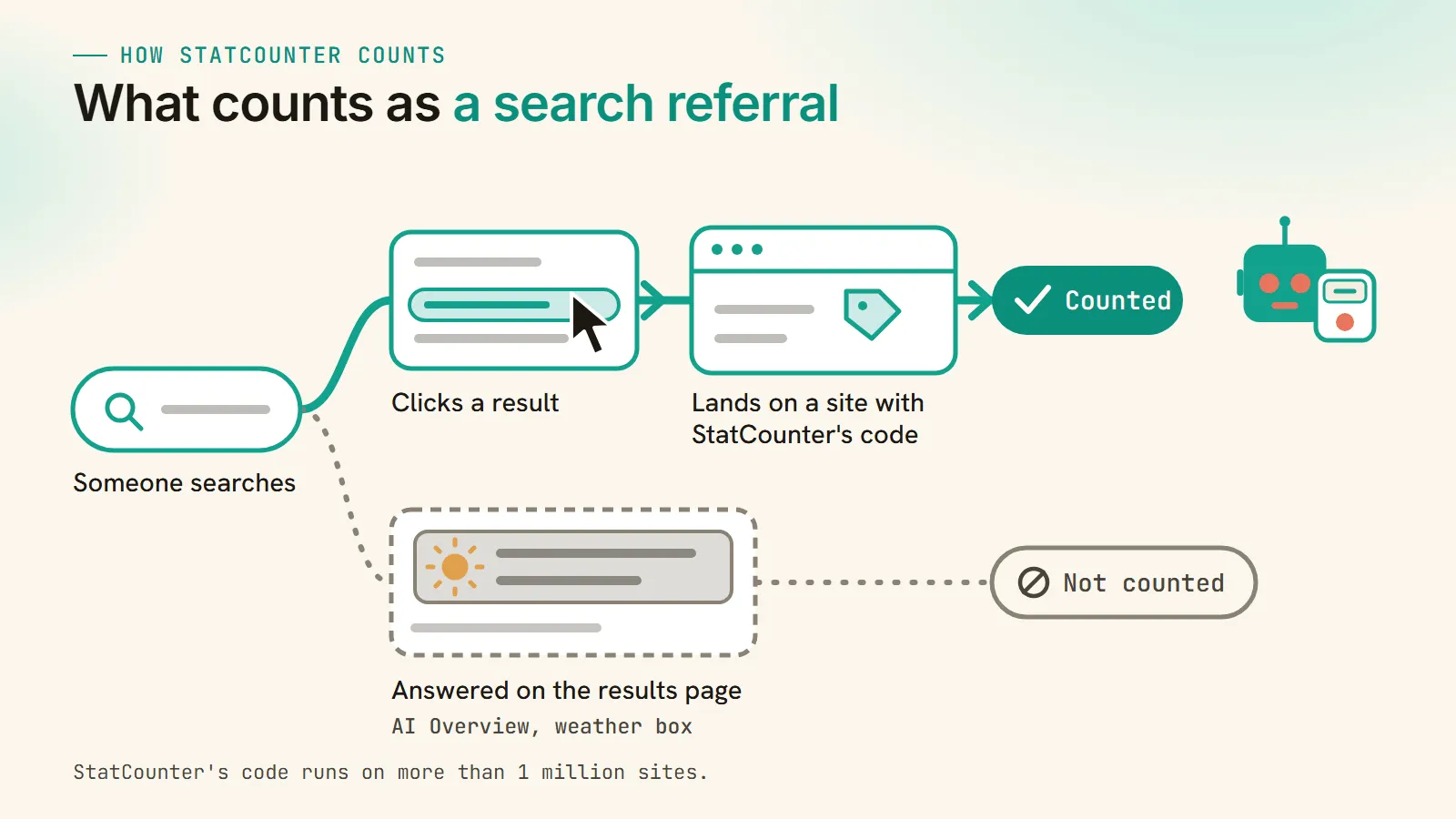
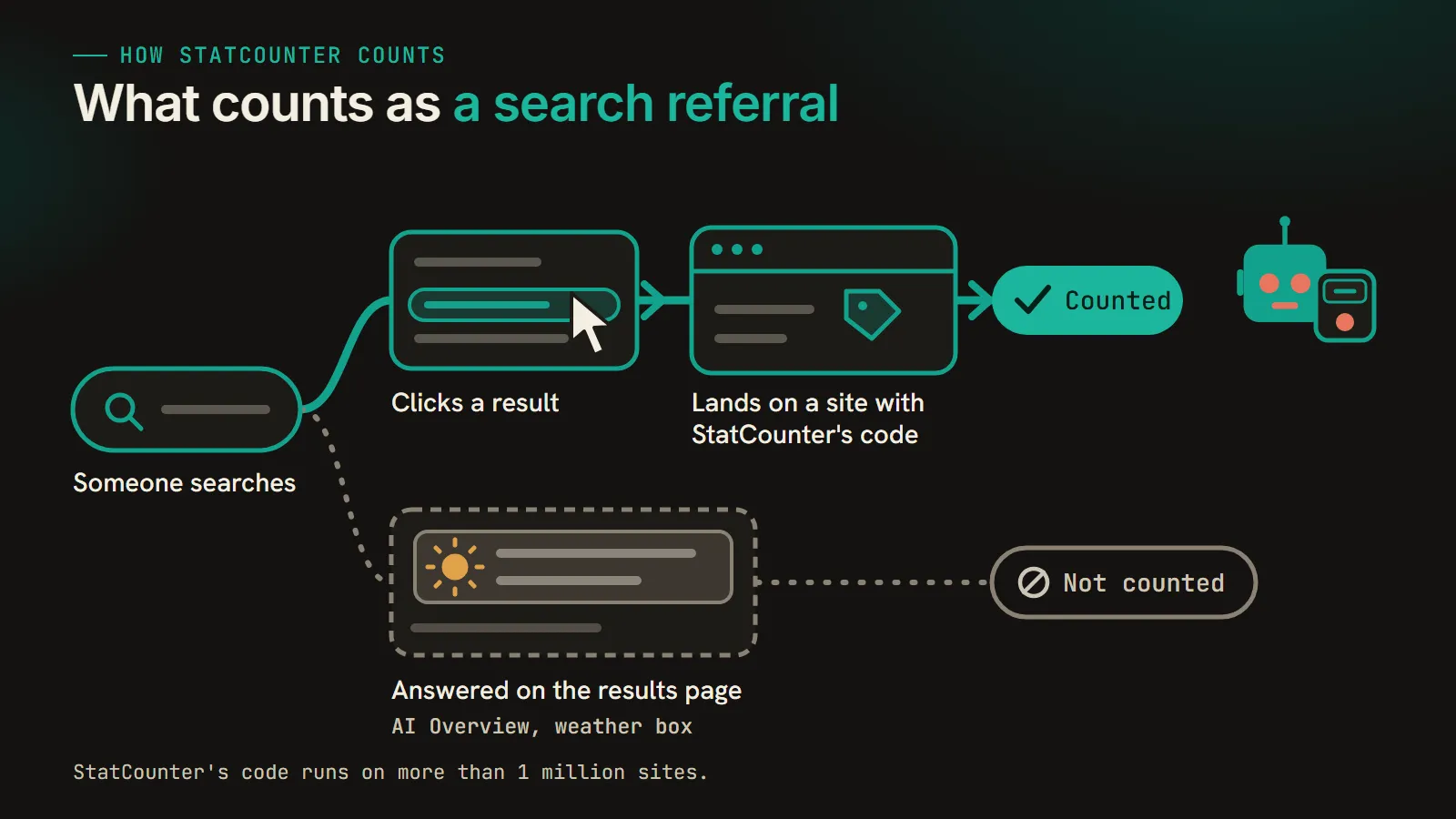
When a search ends without a click, because an AI Overview answered it or the weather box did, it doesn’t show up in StatCounter’s numbers at all. For a site owner that’s fine, since referrals are the visits that reach your site, though it makes the number a rougher guide to how many people use each engine.
Four ways to measure “largest”
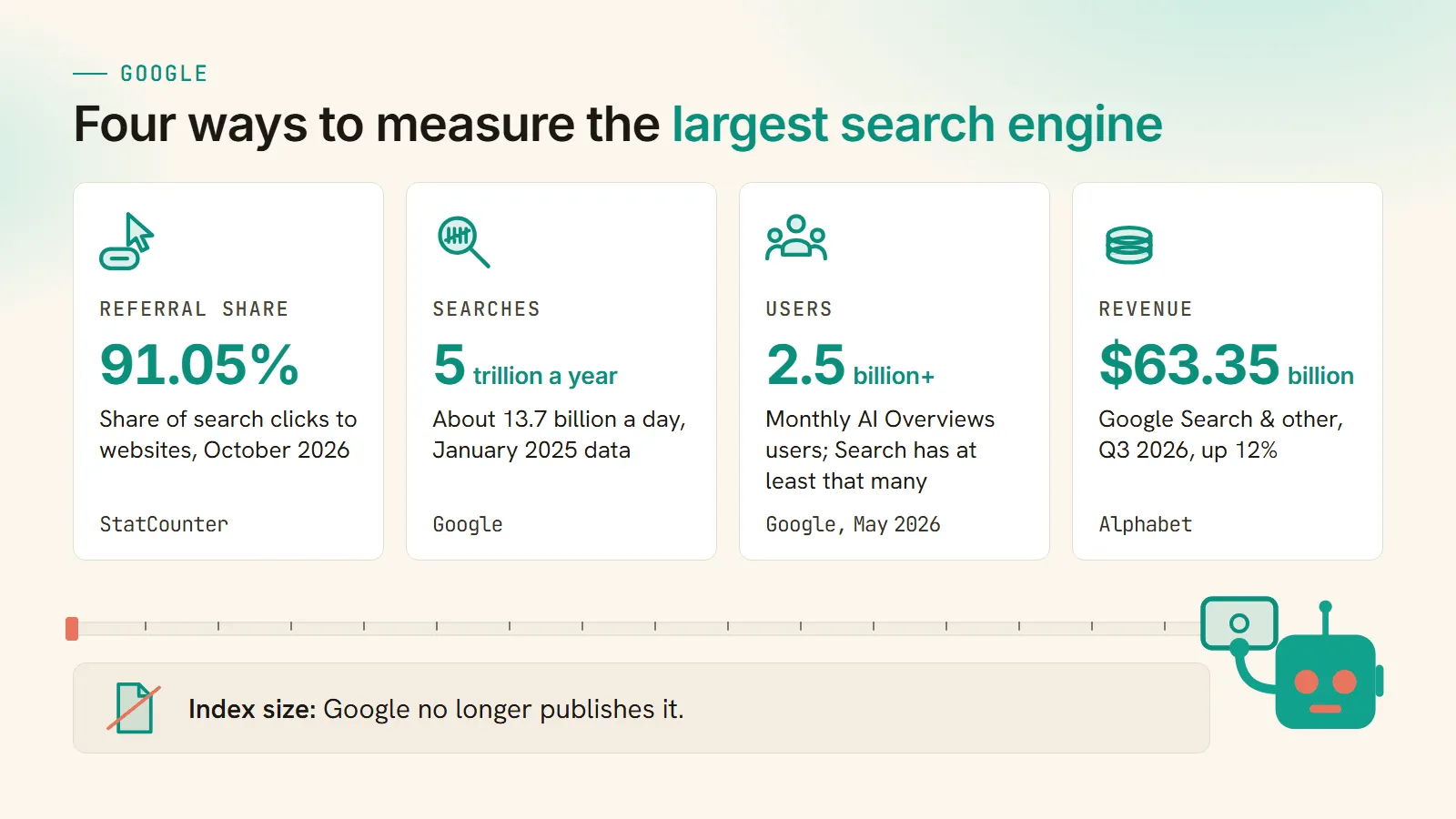
People use four different numbers when they call a search engine the biggest, and StatCounter’s referral share is the only one published for every engine. Google also used to publish an index size (how many pages it holds) but stopped; Guinness World Records notes this on its record page.5
The first is share of search referrals, which is StatCounter’s 91.05% for October 2026.1 Most of the pages that rank for this question quote it, and four of the eight AI answers I got on November 6 repeated it exactly.
For the raw number of searches, Google published a figure of “more than 5 trillion searches on Google annually” in March 2025, from its internal data for January 2025.6 Divide 5 trillion by 365 and you get roughly 13.7 billion a day. SparkToro, in its March 2025 comparison with ChatGPT, put Google at more than 14 billion searches a day.7 That’s close to what 5 trillion a year works out to, and SparkToro says its Datos panel data also matched Google’s annual figure, so I’d treat 13 to 14 billion a day as the range. You’ll also see 8.5 billion a day on a lot of blogs, and I couldn’t find where it comes from.
Users would be the obvious third measure, but Google doesn’t publish a monthly user count for Search as a whole. The closest it gets is its AI features: in a May 19, 2026 post, Sundar Pichai said AI Overviews has over 2.5 billion monthly active users and AI Mode has surpassed 1 billion monthly active users.8 Both live inside Search, so Search has at least 2.5 billion monthly users; Google hasn’t said how many more.
Alphabet reported $63.35 billion in “Google Search & other” revenue for the third quarter of 2026, up from $56.57 billion a year earlier, which is 12% growth.2 Baidu reports its own online marketing revenue (RMB 13.1 billion in the second quarter, more on that in the China section), but the two companies don’t break their numbers out the same way, so revenue doesn’t rank the engines cleanly.3
Top 5 search engines by market share in 2026
The top five worldwide are Google, Bing, Yahoo, Yandex and DuckDuckGo, in that order. The table has StatCounter’s October 2026 referral shares for four views (worldwide, desktop, mobile and the US), and the last column is my own read.191011
| Search engine | Worldwide, all platforms | Desktop | Mobile | United States | Who it matters to |
|---|---|---|---|---|---|
| 91.05% | 77.93% | 96.35% | 85.45% | Every site | |
| Bing | 4.8% | 15.03% | 0.61% | 9.78% | Sites with desktop or US audiences |
| Yahoo | 1.18% | 3.32% | 0.36% | 2.54% | A small US desktop slice |
| Yandex | 1.14% | 1.48% | 1.01% | 0.32% | Sites selling into Russia |
| DuckDuckGo | 0.64% | 0.93% | 0.53% | 1.74% | A small US slice |
| Baidu | 0.42% | 0.35% | 0.45% | not in top six | Sites selling into China |
Google’s lead is biggest on phones, where it has 96.35% of referrals and the next engine, Yandex, has 1.01%. Desktop is its weakest of the four views at 77.93%, and most of the rest of desktop is Bing.109
Almost all of Bing’s share is desktop, as the table shows. Microsoft also scheduled the public Bing Search APIs for retirement on August 11, 2025 and now points developers to “Grounding with Bing Search” for web data in Azure AI Agents.12 I’d expect searches made that way not to show up in a referral count.
Yahoo, Yandex, DuckDuckGo and Baidu are all under 1.2% worldwide. Yahoo’s share is mostly desktop (3.32% there, 0.36% on phones), which is enough to make it third in the US at 2.54%.91011 Yandex’s base is Russia, where it has 70.22% of referrals.13 DuckDuckGo gets 1.74% in the US, almost three times its worldwide share, and Baidu’s 0.42% puts it sixth worldwide even though it leads in China.111 StatCounter lists only six engines at each view, so Brave, Ecosia, Naver and others sit below that line worldwide; Ecosia does make the US list, in sixth place with 0.11%.11
What is the second largest search engine?
By worldwide search referrals, Bing is the second largest search engine, with 4.8% in October 2026.1 On desktop it’s well clear of third place, 15.03% against Yahoo’s 3.32%.9 On mobile, second place goes to Yandex at 1.01%, because Bing drops to 0.61% there.10
YouTube is the usual alternative answer. “YouTube is the second largest search engine” turns up on a lot of SEO pages, and Google’s AI Mode repeated it to me on November 6, saying YouTube was second “by search volume.” I looked for a dataset that measures YouTube searches in the same units as web search share and couldn’t find one, so I wouldn’t treat it as a ranking.
The most used search engine by country
Google leads in most countries. The four below are the US plus three markets where another engine is first or close behind, using StatCounter’s October 2026 referral figures for all platforms.11131415
| Country | First | Second | Others in the top six |
|---|---|---|---|
| United States | Google 85.45% | Bing 9.78% | Yahoo 2.54%, DuckDuckGo 1.74% |
| Russia | Yandex 70.22% | Google 28.36% | Bing 0.82% |
| South Korea | Google 48.48% | Naver 42.25% | Bing 4.94% |
| China | Baidu 49% | Bing 21.69% | Yandex 11.77%, Haosou 8.67%, Google 6.83% |
Russia is the only one of the four where a local engine has a clear majority, and South Korea is the closest race, with Naver about six points behind Google.14
The most used search engine in China is Baidu, with 49% of referrals, while Bing has 21.69% and Google 6.83%.15 I’d read those numbers as a rough guide only, because StatCounter counts just the sites carrying its code,4 and I don’t know how well that sample covers the Chinese web. Baidu’s own filing is a better gauge of its size: the Baidu App had 644 million monthly active users in June 2026, and the company’s online marketing revenue fell 19% year over year to RMB 13.1 billion in the second quarter.3
Is Google still the most popular search engine?
Yes, with 91.05% of referrals in October 2026.1 StatCounter’s data had Google below 90 percent of global search in late 2024 for the first time since 2015 (I wrote about that dip in the history of AI search), and October’s figure puts it back above that line.16
The number of searches has kept growing as well. Google disclosed 1.2 trillion searches a year in 2012, 2 trillion in 2016 and more than 5 trillion with its January 2025 data.6 In Alphabet’s October 28 earnings release, Pichai said “our year-over-year query growth rate is the highest it’s been in the last five years.”2
For an older reference point, Guinness World Records lists Google as the largest internet search engine with a record dated January 2011, citing 65.6% market share and 11.1 billion searches in the USA that month.5 That’s a US figure from a different method, so it can’t go on the same line as StatCounter’s worldwide number, but Google was first then too.
I think defaults and habit keep Google there, helped by Google owning Android and Chrome (Chrome had 68.79% of the worldwide browser market in October 2026, though browser share doesn’t prove anything about search on its own).17
Is ChatGPT a search engine, and how big is it next to Google?
ChatGPT can search the web, and plenty of people use it for things they used to type into Google, but it gets measured in different units. ChatGPT reports conversations, prompts and weekly users, and a lot of those conversations (drafting an email, fixing a spreadsheet formula) aren’t searches at all. Google and StatCounter report queries and referrals. Putting a headline ChatGPT user number next to Google’s market share tells you very little, and the closest thing to a like-for-like comparison I found is StatCounter’s.
Going by StatCounter and SparkToro, the AI answer engines have taken a small slice of search so far. StatCounter’s Google vs ChatGPT comparison page showed Google at 99.91% and ChatGPT at 0.09% in October 2026.18 StatCounter doesn’t say how it builds that page, so I’m assuming it’s the same referral count as the main table, limited to those two.
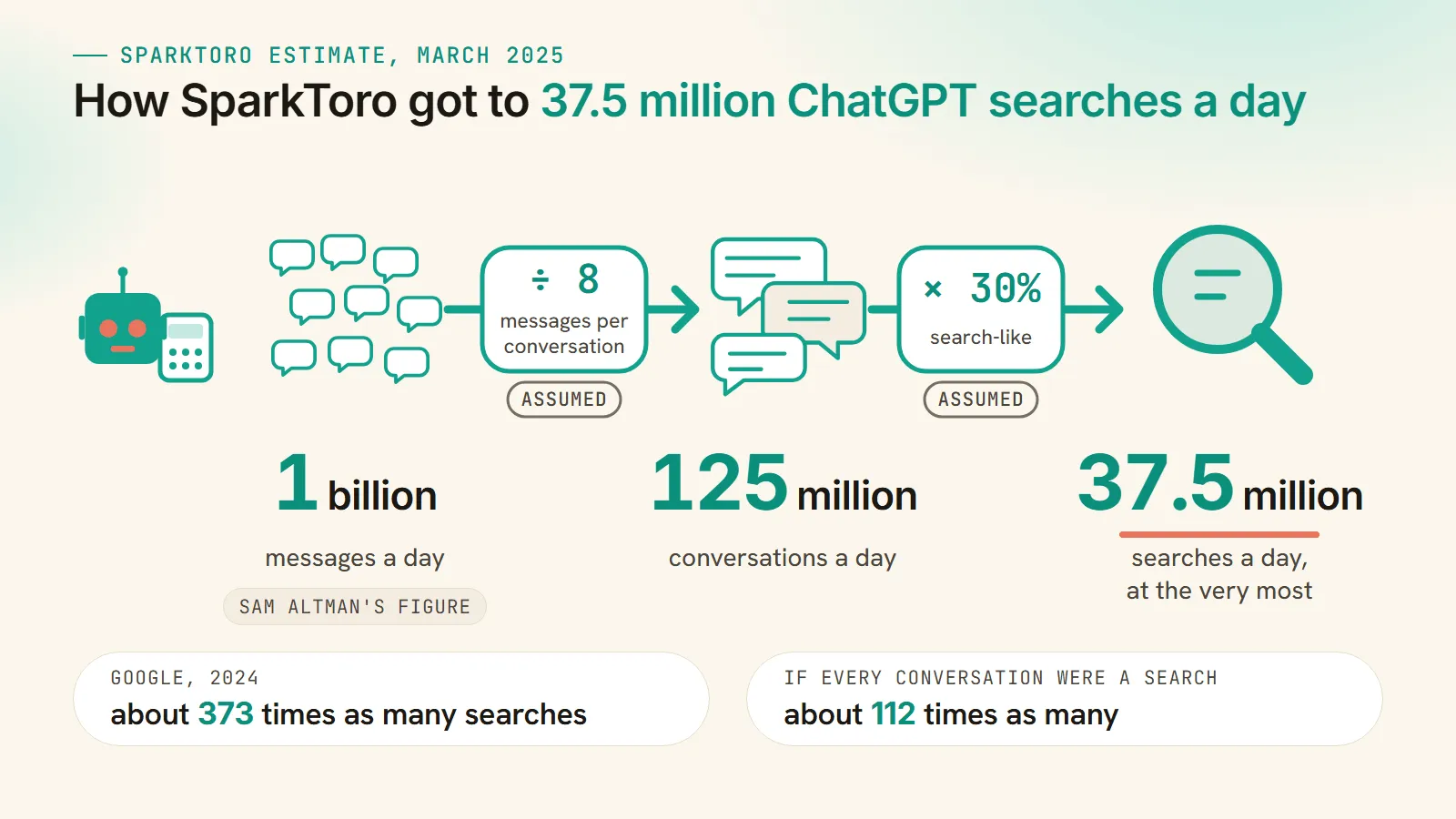
SparkToro estimated that Google received about 373 times as many searches as ChatGPT in 2024, and put ChatGPT at “(at the very most) 37.5M searches/day.”7 It’s an estimate built on assumptions (SparkToro started from Sam Altman’s figure of 1 billion messages a day, assumed 8 messages per conversation, and assumed 30% of conversations were search-like), and if any of the three is off, so is the ratio. Even if every conversation counted as a search, which on those numbers is 125 million a day, Google would still have had about 112 times as many.
Similarweb ranked chatgpt.com fifth among the most popular websites in the world for September 2026, behind google.com, youtube.com, facebook.com and instagram.com.19 That ranking counts visits to chatgpt.com itself, which is a separate thing from StatCounter’s 0.09%. Gemini, Google’s own chatbot, “has reached one billion users,” per Alphabet’s Q3 2026 release, which doesn’t say whether that’s monthly or weekly.2
Pew looked at the browsing data of 900 US adults in March 2025 to see what Google’s own AI summaries do to clicks. People clicked a traditional search result in 8% of visits when an AI summary appeared, against 15% when one didn’t.20 AI Overviews and AI Mode answer the question on Google’s page, and that can cut the clicks Google sends without touching its share of referrals, since the share is measured against the other engines. I covered where Google is taking this in how Google Search is trending in 2026, and I argued in what everyone got wrong about SEO trends that the AI engines hadn’t replaced Google in 2025, which is still where I’d put it in late 2026.
What AI search engines say when you ask them
I asked six AI search engines “what is the largest search engine in the world” on the morning of November 6, 2026 (7:13 to 7:20, Mountain time). On some of them I added two follow-ups: “is google still the biggest search engine or is chatgpt overtaking it” and “which search engine has the most users worldwide.” I was signed out, in US English, in one browser. That came to 12 queries and 8 AI answers, and each one is a single snapshot of a system that can answer differently every time.
| Engine | Google’s share it gave | Daily Google searches it gave | Main source cited |
|---|---|---|---|
| Google AI Overviews | No AI Overview on any of the 3 prompts | n/a | n/a |
| Google AI Mode | 91.05% in one answer, “over 90%” in the other | 8.5 billion in one answer, 14 billion in another | StatCounter in one answer, blogs and news in the other |
| ChatGPT search | 91.05% in all 3 answers | None given | StatCounter |
| Bing | 90.01% to 90.83% | Over 14 billion | Reliablesoft, Search Engine Journal, Search Endurance |
| Perplexity | About 90% | None given | Not visible signed out |
| Brave | No AI summary | n/a | n/a |
On Google itself there was no AI Overview for any of the three questions, just a StatCounter snippet at the top reading 91.04% for Google and 4.77% for Bing (a hair off the table I read the same morning). ChatGPT search was the only one to point out that market share isn’t the same as unique users, and Bing’s answer didn’t cite StatCounter at all.
StatCounter was the source named most often, in 4 of the 8 answers (the two Perplexity answers didn’t show theirs). Those four (AI Mode’s first answer and all three of ChatGPT’s) all gave 91.05%, the figure on StatCounter’s page that morning. The daily search figures didn’t line up (8.5 billion in one AI Mode answer, 14 billion in the other and in Bing’s), probably because the only primary number is Google’s 5 trillion a year and the engines fill the gap from blogs.
Which search engines should a site owner care about?
Google comes first, since almost everything you do for SEO is aimed at it. Bing comes second, mainly if your audience is on desktop or in the US (15.03% of desktop referrals and 9.78% of US ones),911 and also because Microsoft now offers its index to AI agents through Grounding with Bing Search.12 Verifying your site in Bing Webmaster Tools and submitting a sitemap covers most of that, and I went through sitemaps in what a sitemap is. If you sell into Russia, China or South Korea, add Yandex, Baidu or Naver to the list.
For the AI answer engines, I’d measure what they send you now before doing anything else (I wrote that up in AI search visibility metrics), and check that your site lets their crawlers in with the AI crawler checker. If showing up in Google’s own AI answers is the goal, how AI Overviews choose sources covers that.
Frequently asked questions
What is the largest search engine in the world?
Google. In October 2026 it had 91.05% of search engine referrals worldwide according to StatCounter, with Bing second at 4.8%. StatCounter counts clicks from search engines to the sites carrying its code, so searches that end without a click aren't in the figure.
What is the second largest search engine?
Bing is second on worldwide referrals (4.8% in October 2026) and on desktop (15.03%), according to StatCounter. On mobile Bing falls to 0.61%, so Yandex is second there with 1.01%. Which engine is second depends on the device you measure. YouTube is often named too, but I couldn't find data that ranks it in the same units.
Is Google still the most popular search engine?
Yes. Google had 91.05% of worldwide search referrals in October 2026 according to StatCounter, back above 90 percent after its data put Google below that line in late 2024 for the first time since 2015. Search volume keeps growing too: Google reported more than 5 trillion searches a year, based on its January 2025 data.
What are the top 5 search engines?
By StatCounter's October 2026 worldwide referral share, the top 5 search engines are Google at 91.05%, Bing at 4.8%, Yahoo at 1.18%, Yandex at 1.14% and DuckDuckGo at 0.64%. Baidu is sixth at 0.42%. These are shares of referrals to the sites carrying StatCounter's code, and it's the number most sites quote.
How many searches does Google get per day?
Google reported, with data from January 2025, more than 5 trillion searches a year, which works out to roughly 13.7 billion a day. SparkToro's 2025 comparison with ChatGPT puts Google at more than 14 billion a day. The 8.5 billion figure that shows up on many blogs has no source I could find.
Is ChatGPT a search engine?
It can search the web. Its usage is reported in conversations and users, and many conversations (drafting an email, fixing a formula) aren't searches. On StatCounter's Google vs ChatGPT comparison page, ChatGPT had 0.09% to Google's 99.91% in October 2026, and SparkToro estimated Google had about 373 times as many searches as ChatGPT in 2024.
What is the most used search engine in China?
Baidu, with 49% of search referrals on StatCounter in October 2026. StatCounter only counts sites carrying its code, so treat that as a rough guide. Baidu's own filing says the Baidu App had 644 million monthly active users in June 2026.
Is YouTube the second largest search engine?
I can't say, because I couldn't find any data that measures YouTube searches in the same units as search engine share. It's often called the second largest, and Google's AI Mode said so when I asked in November 2026, but I wouldn't treat it as a ranking.
Keep going
Where the AI answer engines came from and how to measure the traffic they send you.
Sources
-
StatCounter Global Stats, Search Engine Market Share Worldwide, October 2026, all platforms (accessed November 6, 2026). ↩ ↩2 ↩3 ↩4 ↩5 ↩6 ↩7
-
Alphabet, Q3 2026 earnings release, Form 8-K exhibit 99.1 (October 28, 2026). ↩ ↩2 ↩3 ↩4
-
Baidu, Inc., Q2 2026 results, Form 6-K exhibit 99.1 (August 18, 2026). ↩ ↩2 ↩3
-
StatCounter Global Stats, FAQ (accessed November 6, 2026). Source for the referral definition and the “more than 1 million sites” figure. ↩ ↩2 ↩3
-
Guinness World Records, Largest internet search engine. ↩ ↩2
-
Google, AI, personalization and the future of shopping (March 3, 2025), citing Google internal data from January 2025; reported by Search Engine Roundtable, Google: 5 trillion searches per year (March 4, 2025), which also gives the 2012 and 2016 disclosures. ↩ ↩2
-
SparkToro, New research: Google search grew 20%+ in 2024, receives 373x more searches than ChatGPT (March 11, 2025). SparkToro states the 14 billion a day figure without showing how it was derived, and says its Datos panel analysis confirmed Google’s annual figure; the ChatGPT comparison draws on Datos clickstream panel data (US desktop panel, January 2023 to January 2025). SparkToro marks the post as possibly out of date. ↩ ↩2
-
Google, Sundar Pichai on what we announced at I/O 2026 (May 19, 2026). ↩
-
StatCounter Global Stats, Desktop Search Engine Market Share Worldwide, October 2026 (accessed November 6, 2026). ↩ ↩2 ↩3 ↩4 ↩5
-
StatCounter Global Stats, Mobile Search Engine Market Share Worldwide, October 2026 (accessed November 6, 2026). ↩ ↩2 ↩3 ↩4
-
StatCounter Global Stats, Search Engine Market Share in United States Of America, October 2026 (accessed November 6, 2026). ↩ ↩2 ↩3 ↩4 ↩5 ↩6
-
Microsoft Learn, Bing Search API retirement. ↩ ↩2
-
StatCounter Global Stats, Search Engine Market Share in Russian Federation, October 2026 (accessed November 6, 2026). ↩ ↩2
-
StatCounter Global Stats, Search Engine Market Share in Republic Of Korea, October 2026 (accessed November 6, 2026). ↩ ↩2
-
StatCounter Global Stats, Search Engine Market Share in China, October 2026 (accessed November 6, 2026). ↩ ↩2
-
Search Engine Land, Google search market share drops below 90% for first time since 2015, citing StatCounter data for Q4 2024. ↩
-
StatCounter Global Stats, Browser Market Share Worldwide, October 2026 (accessed November 6, 2026): Chrome 68.79%. ↩
-
StatCounter Global Stats, Google vs ChatGPT Market Share, October 2026 (accessed November 6, 2026). StatCounter publishes no methodology for this comparison. ↩
-
Similarweb, Top Websites Ranking, September 2026 (accessed November 6, 2026). ↩
-
Pew Research Center, Google users are less likely to click on links when an AI summary appears in the results (July 22, 2025). 900 US adults, browsing data from March 2025. ↩
Working on this same shift?
I write about SEO, GEO, and getting found by AI search.
If this resonated, I'd love to compare notes.