
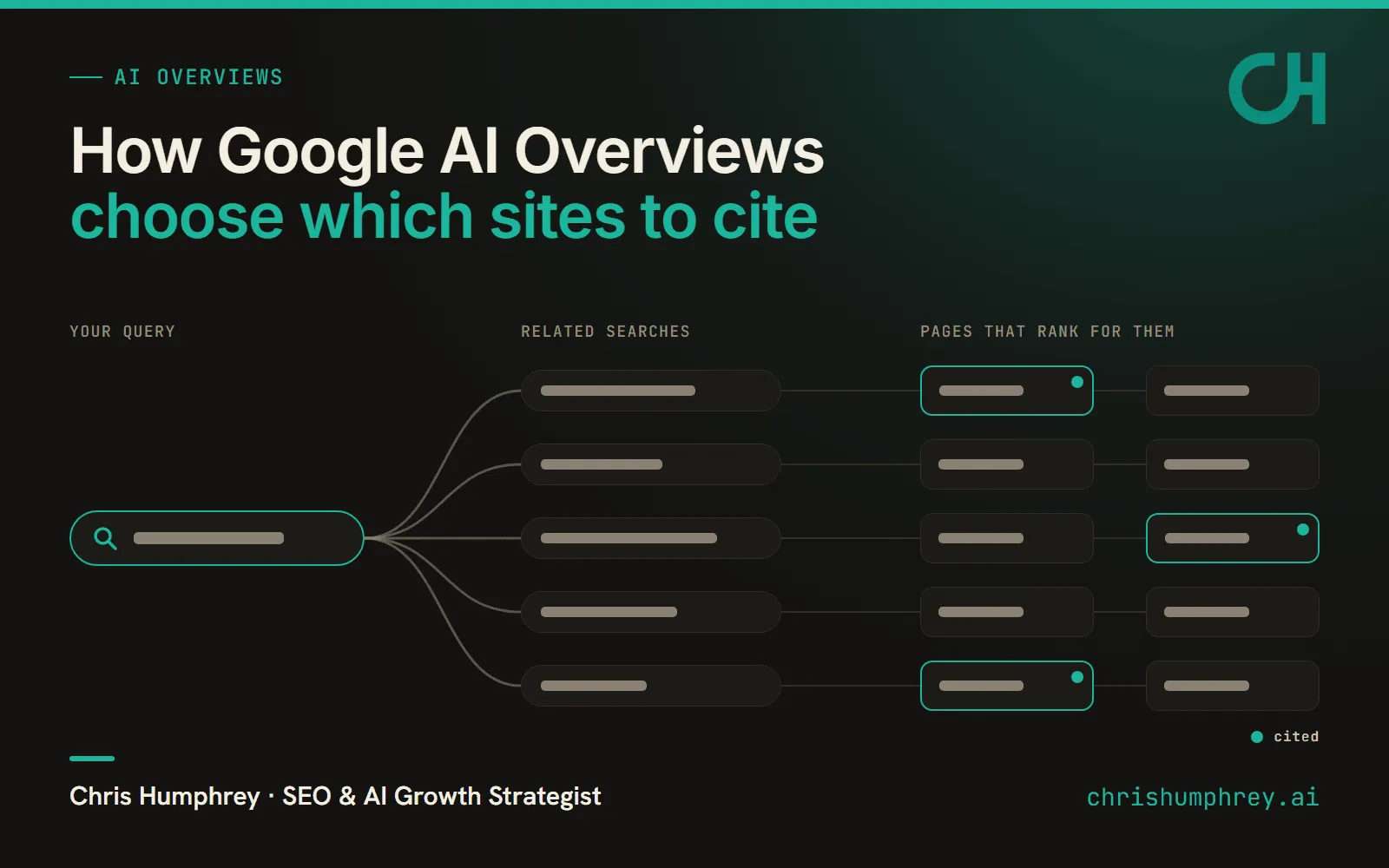
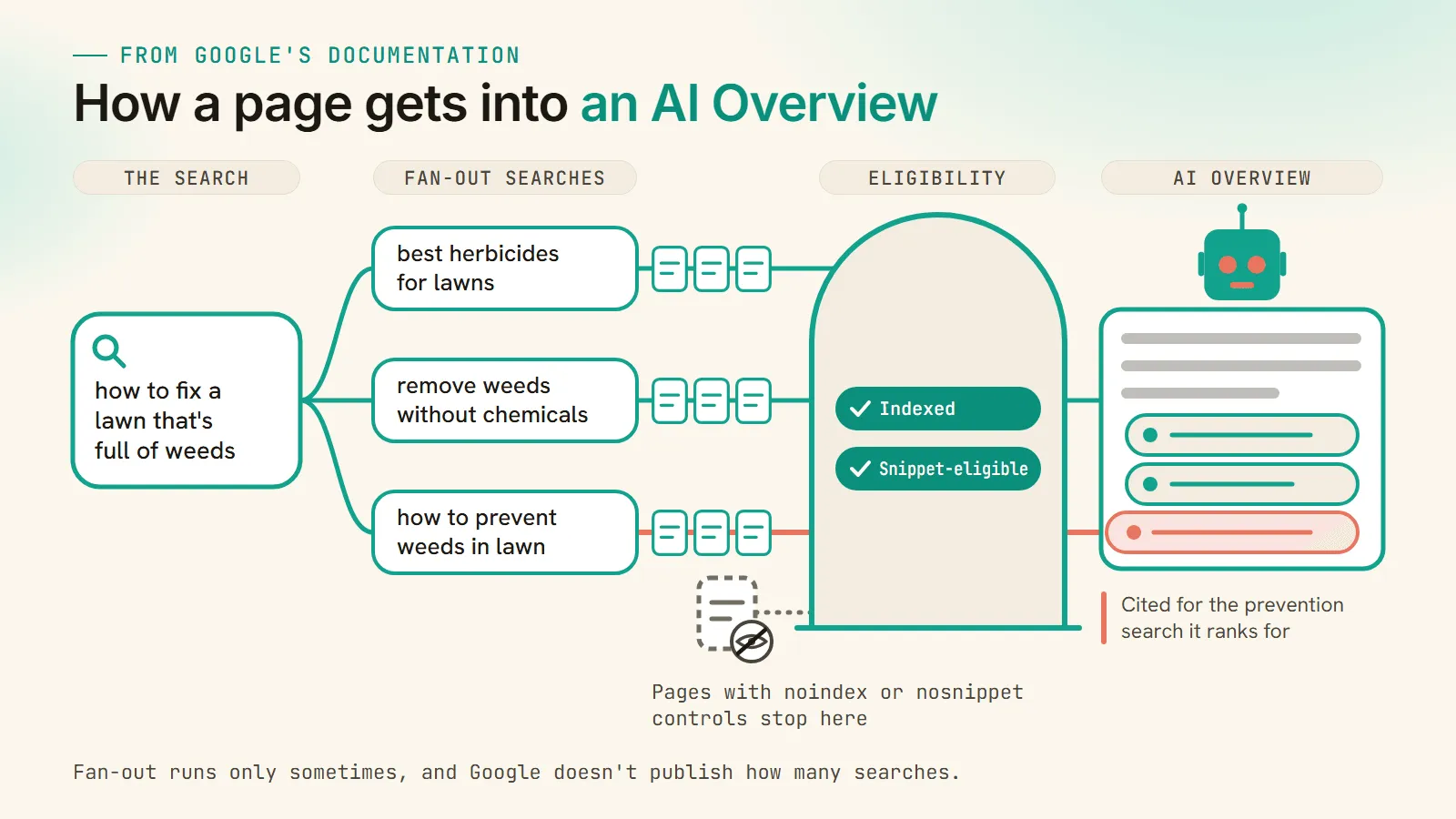
Google says the model that writes an AI Overview starts from the query, sometimes adds a batch of related “fan-out” searches, and picks up more supporting pages as it writes the answer (Google’s phrase is “identify more supporting web pages”). The only bar Google states in writing is that a page has to be indexed and eligible to show in Search with a snippet.1 I read that rule as meaning the pool is Google’s own index, though Google doesn’t say so directly, and index and snippet eligibility is the first thing I’d check on any page that isn’t getting cited.
Everything past that is measured by outside studies, and they put the share of AI Overview citations that rank in Google’s top 10 anywhere from about 17%2 to 76%,3 on a feature that now shows up on about 48% of the queries BrightEdge tracks.2 On October 19, 2026 I lined up six of those studies against Google’s own documentation and ran this question, in a couple of phrasings, through Google, AI Mode, ChatGPT search, Bing, Brave and Perplexity (nine checks, five of which returned an answer). I think ranking still matters, but in Surfer’s data, pages that ranked only for the sub-questions Google fans out to were cited more often than pages that ranked only for the query you typed. In the newer data, most citations come from pages outside the main query’s top 10. I didn’t find any evidence that llms.txt files or special schema help a page get cited.
What Google says about how AI Overviews pick sources
The AI features page on Search Central says “a page must be indexed and eligible to be shown in Google Search with a snippet.” The same page says “There are no additional requirements to appear in AI Overviews or AI Mode, nor other special optimizations necessary,” and it rules out the add-ons people sell: “You don’t need to create new machine readable files, AI text files, or markup,” and there’s “no special schema.org structured data that you need to add.”1 Its AI optimization guide (updated July 10, 2026) adds that there’s no need to break content into tiny pieces, and its mythbusting section says Google Search doesn’t use llms.txt files.4 (The llms.txt question has its own post.)
The same page describes query fan-out as “issuing multiple related searches across subtopics and data sources.” Google says that lets it “display a wider and more diverse set of helpful links.” AI Overviews and AI Mode “may use different models and techniques, so the set of responses and links they show will vary,”1 and in Ahrefs’ September 2025 data only 13.7% of citations overlapped between the two features, across 540,000 query pairs.5
A page with noindex, nosnippet, data-nosnippet on the relevant text, or a tight max-snippet value is limited in AI Overviews or kept out of them, the same way it is for regular snippets.1 John Mueller’s May 2025 post on AI search says “More restrictive permissions will limit how your content is featured in our AI experiences,” and its content advice is to focus on “unique, non-commodity content.”6 Neither page says how the model chooses among the pages fan-out brings back or how much ranking position counts, and Google doesn’t say how many sub-queries a given search runs.
How query fan-out widens the pool of pages Google can cite
Fan-out means a page can be cited because it ranks for a sub-question the searcher never typed. Google’s own example: someone searches “how to fix a lawn that’s full of weeds,” and the fan-out queries might include “best herbicides for lawns,” “remove weeds without chemicals,” and “how to prevent weeds in lawn.”4 A page that ranks well for the prevention query and nowhere for the original question can still end up in the Overview. The RAG post covers the retrieval side of query fan-out in more detail.
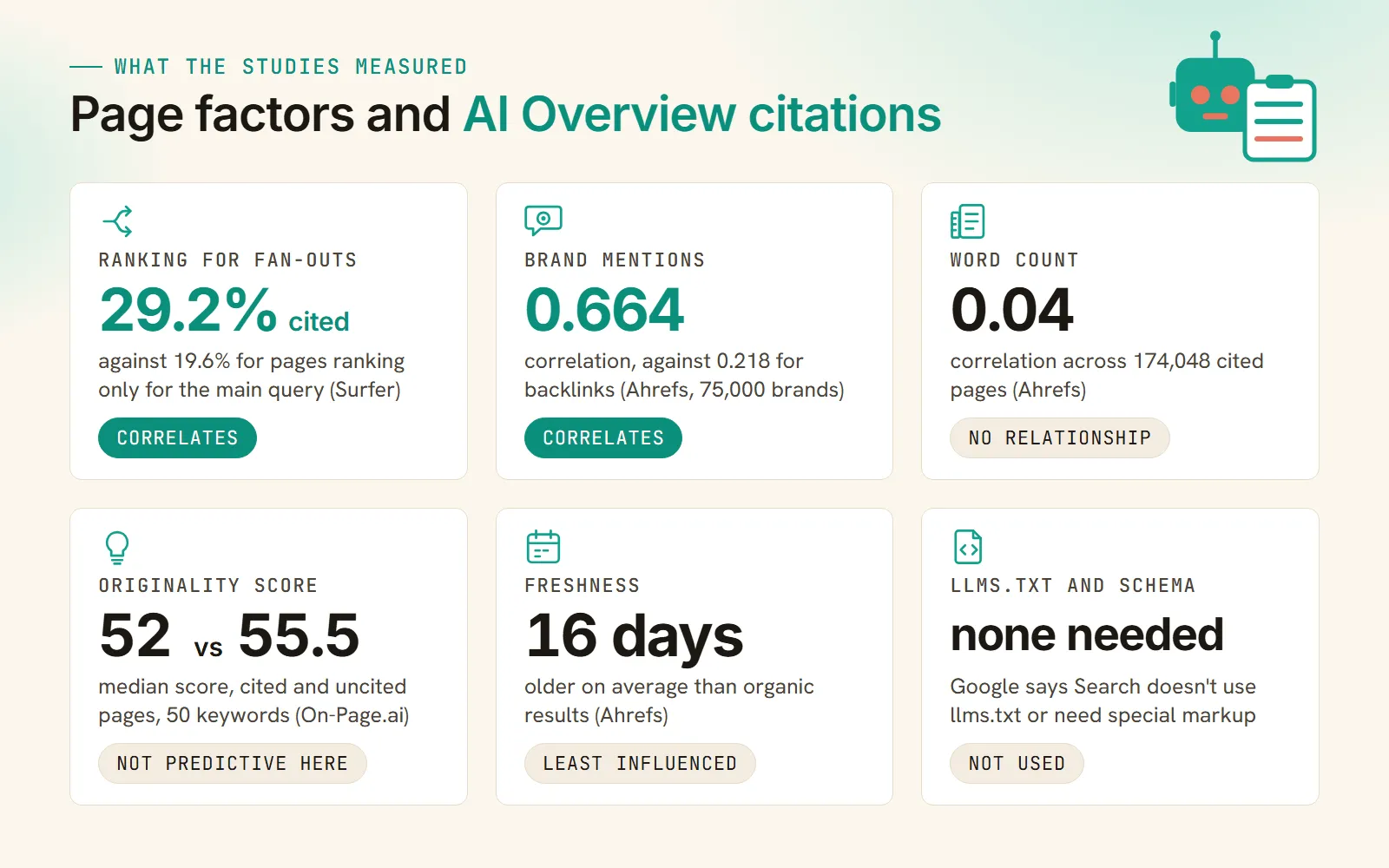
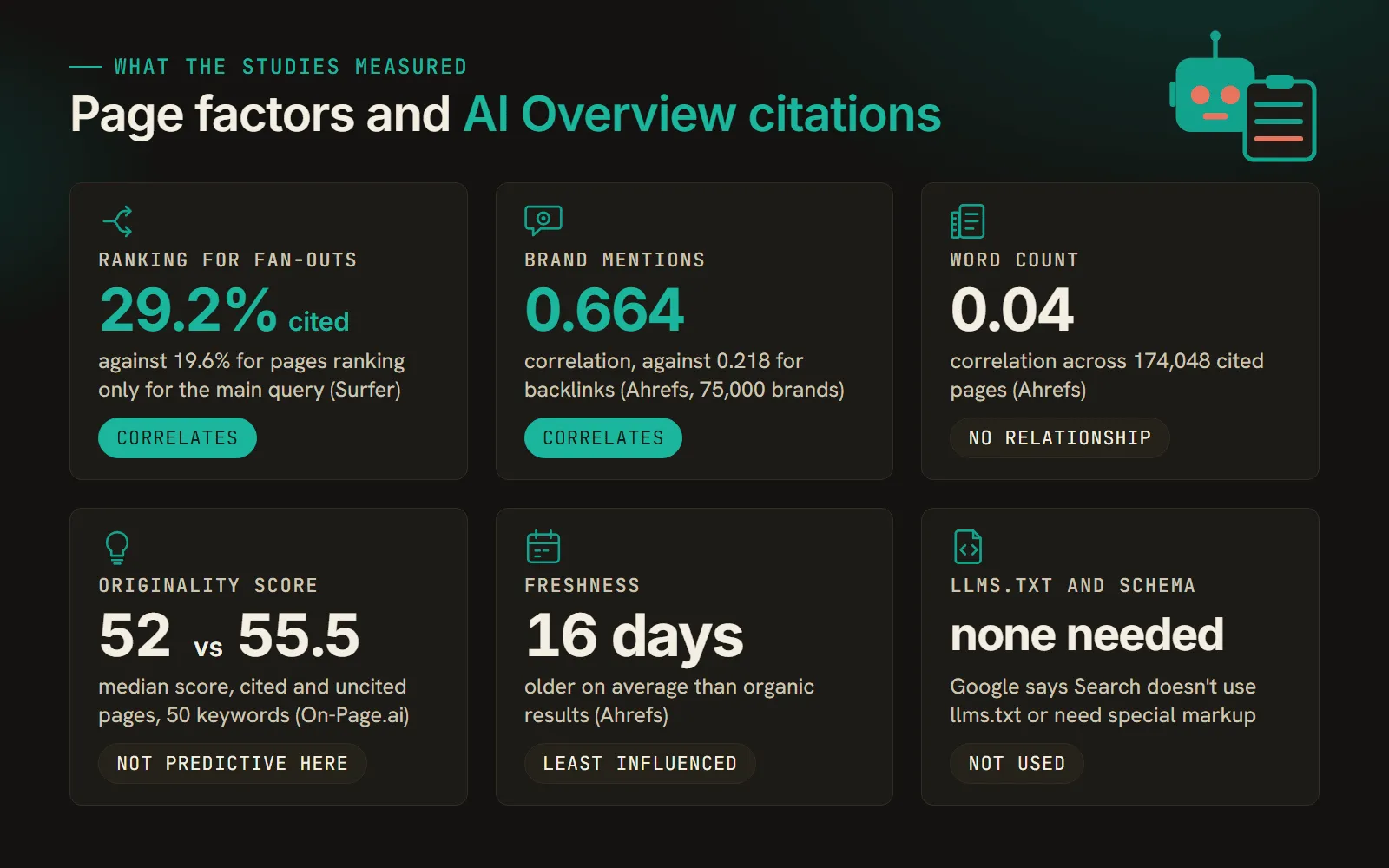
Surfer has a large study measuring it, built on the top 10 pages for 10,000 keywords (173,902 URLs, about 33,000 fan-out queries). Pages ranking for the main query and its fan-outs were 161% more likely to be cited, and pages ranking only for fan-outs were cited 29.2% of the time against 19.6% for pages ranking only for the main query. The more fan-outs a page ranked for, the likelier the citation (Spearman 0.77).7 Surfer calls all of this correlation, and it also found only about 27% of fan-outs stay consistent across repeated searches for the same prompt, so the sub-queries a page would need to rank for change from one search to the next.7 (Surfer sells an AI visibility tracker, and On-Page.ai, whose originality study comes up below, sells an SEO API with an Information Gain Checker. I don’t sell or resell any of the third-party tools mentioned here, and none of the links are affiliate links.)
Ahrefs’ July 2025 study found that pages cited from beyond the top 10 “appeared for fewer keywords, and returned for shorter queries,”3 which cuts against the idea that low-ranked pages win by matching lots of fan-out sub-queries. Ahrefs’ 2026 rerun says fan-out “may be” the reason fewer citations now come from the top 10,8 and Search Engine Journal noted Google “hasn’t confirmed any specific changes to fan-out behavior.”9
Do you have to rank in the top 10 to get cited in AI Overviews?
In the most recent data I found, most AI Overview citations come from pages outside the query’s top 10, though the citations shown first still lean toward pages that rank, and each study means something different by “top 10.” The six studies, oldest first:
| Study | Sample | What it counted | Share in the top 10 |
|---|---|---|---|
| Ahrefs, July 2025 | 1.9M citations from 1M AI Overviews | Top 3 citations per Overview, organic top 10 | 76.1%3 |
| BrightEdge, Feb 2026 post | Tracked queries (size not stated; the post gives conflicting data windows) | All citations, organic top 10 | About 17%2 |
| Ahrefs, Mar 2026 | 863K keyword SERPs, 4M cited URLs | All citations, first 10 blocks on the page | 37.9% (37.1% for blue links only)8 |
| On-Page.ai, July 2026 | 50 keywords, 584 cited links, one day | All citation links, page one | About 25%10 |
| Surfer, Sept 2026 (source count) | Not stated | Top 10 for the query or any fan-out query | About 70%11 |
| Surfer, Sept 2026 (fan-out) | 10,000 keywords, 173,902 URLs | All citations, top 10 for the main query or any fan-out query | About 32% (54.1% for the top 3)7 |
The spread mostly comes from what each study counted; counting only the three most visible citations in each Overview pushes the share up, to 76.1% in Ahrefs’ 2025 study.3 Surfer’s data points the same direction on a wider definition, with 54.1% of top-three citations ranking in the top 10 for the main query or a fan-out, against about 32% of all citations.7 BrightEdge’s 17% is the organic top 10 only (its top-100 overlap runs about 49% to 53%),2 and Ahrefs’ 2026 rerun counted the first 10 blocks on the page (37.9%) and then blue links alone (37.1%).8
Surfer’s two studies give about 70% and about 32% of citations ranking in the top 10 for the main query or one of its fan-outs, and the pages don’t explain the gap, so I wouldn’t put weight on either number.117 Ahrefs also changed its own method between runs. Its 2026 post compares the two directly (“~76% in July 2025 vs. ~38% today”) and says in the same post that it improved its parsing in between, so the two aren’t a clean before and after.89
The blue-link test in that 2026 study also shows where the rest come from: 37.1% from the top 10, 26.2% from positions 11 to 100, and 36.7% from pages outside the top 100 for the query.8 In On-Page.ai’s 50-keyword, one-day sample, YouTube had 127 of the 584 citation links (22%).10
A couple of my earlier posts, AI Overviews vs classic SEO among them, leaned on the 2025 figure and described the cited pool as mostly the ranking pool, which now only holds for the top three citations in an Overview.
Which page features predict an AI Overview citation
The 1,500 to 2,000 word thresholds that get passed around for AI Overviews don’t come with data I could find, and the biggest test of length I found shows almost no relationship. Ahrefs looked at 174,048 cited pages with valid data, drawn from 560,346 AI Overviews, in December 2025 and found a 0.04 Spearman correlation between word count and citation. 53.4% of cited pages were under 1,000 words, and cited pages averaged 1,282 words against 1,188 for pages ranking organically.12
On-Page.ai ran a test that scores pages for originality with its own Information Gain Score and describes the method. It took 50 keywords across ten verticals in a single day of captures in July 2026 (US English), scored the ranking pages, and compared the ones the Overview cited with the ones it skipped. Cited pages had a median score of 52 and uncited pages 55.5 (p = .07), and the most original page on a results page was cited in 33% of eligible SERPs, below the roughly 50% that random picks would give.10 Legal content was the exception, with cited pages scoring 62 against 49. Fifty keywords on one day is a small sample, and I’d want to see it repeated before reading much into it.
Freshness counts for less with Google than with the AI assistants. In Ahrefs’ July 2025 data (16.975 million cited URLs, dated by when its crawler first saw each page, so approximate), the assistants generally cited newer content than organic search did, while AI Overviews cited content about 16 days older on average than organic results in Ahrefs’ table (the post’s own text gives a slightly different organic baseline), and Ahrefs called Google “the least influenced by content freshness.”13
When Ahrefs checked 75,000 brands in May 2025, mentions of a brand on other sites tracked AI Overview visibility far more closely than links did: 0.664 against 0.218 for backlinks.14 A brand that gets mentioned a lot usually ranks a lot too, so I wouldn’t treat 0.664 as evidence that mentions cause citations.
Google says no schema is needed for AI Overviews,1 and none of the studies I read show it raising the odds of a citation. It still earns rich results where a page qualifies, so I’d leave existing markup alone.
What I saw when I ran this question through six AI engines
On October 19, 2026 I ran nine checks between 9:14 and 9:30 p.m. Mountain time, logged out, in US English, going to each engine by URL: Google (two phrasings), AI Mode (two), ChatGPT search, Bing’s Copilot answer, Brave (two), and Perplexity. Each is a single snapshot of a system that changes from one run to the next.
Google showed no AI Overview for either phrasing I tried, only organic results. AI Mode answered both of its prompts, and one of those answers said Wikipedia (24.3%) and Reddit (21.6%) lead the sources it draws from, with no source given. Brave gave a summary for one of its two phrasings, and it said roughly 76% of citations come from the top 10, which is the July 2025 number, while a Reddit post in the same results quoted about 38%. The most hedged answer came from ChatGPT search, which was also the only one to cite Google’s own documentation. Perplexity wanted me to sign up before it would answer, and I didn’t.
Query fan-out came up in all five answers I got. Three of them (AI Mode, Bing, and Brave) cited bluetree.digital, whose page still presents Ahrefs’ 76.1% from July 2025 as the current figure.
Semrush’s US database that same day shows 880 monthly searches for “how to rank in ai overviews” and none for “how does google ai overview choose sources” (roughly how this post’s title phrases it), so most people come at this as a how-to.
How to rank in AI Overviews, going by the evidence
In the order I’d check them (most of it is ordinary SEO):
- Check that the page is indexed and snippet-eligible. Look for noindex, nosnippet, data-nosnippet wrapped around the part you want quoted, and max-snippet values tight enough to cut an answer off.1 My AI content visibility checker shows how much of a page is readable in raw HTML.
- Rank for the question and the sub-questions it obviously fans out to, either on one page or across a small cluster of pages that link to each other.7 People Also Ask and the related searches for the query are a reasonable stand-in for the fan-outs (a guess, since Google doesn’t publish the real ones).
- Write what other pages don’t already say. That’s Google’s advice (“unique, non-commodity content”6), and I’d follow it even though On-Page.ai’s small test didn’t find originality scores predicting citation.10 Length doesn’t predict it either,12 so padding a page toward a word count won’t help.
- Consider video for topics where a demo or walkthrough helps; YouTube had 127 of the 584 citation links (22%) in On-Page.ai’s sample.10
- Get the brand mentioned on other sites. It’s the strongest correlation in Ahrefs’ brand data (0.664, against 0.218 for backlinks),14 with the ranking caveat from earlier.
- Leave out the AI-specific add-ons. Google says Search doesn’t use llms.txt and needs no special markup or chunked rewrites.14
The formatting side of showing up in AI Overviews (answers up top, headings that match the questions people ask) is covered in its own post.
How to track whether your pages get cited in AI Overviews
Search Console now reports AI Overview and AI Mode impressions for every site, so start there. Google says the generative AI performance report reached all websites worldwide as of August 31, 2026. The reports list impressions by page, country, device, and date for generative AI features such as AI Overviews and AI Mode (Discover has its own view). Google’s announcement lists impressions as the only metric and says more may come; it doesn’t mention clicks or the queries behind them.15 I wrote up what the report shows and leaves out when it went live.
Seer Interactive’s 2026 update (53 brands, 2.43 billion organic impressions) suggests being cited helps clicks; brands on informational queries got about 120% more organic clicks per impression when an Overview cited them than when it didn’t, though that was still 38% below queries with no AI Overview at all.16
Third-party tracking tools can sample which pages get cited across a set of prompts, but they can’t see the fan-out queries, and with only about 27% of fan-outs holding steady from one search to the next,7 I’d rerun the same prompts every couple of weeks and go by the trend.
Frequently asked questions
How does Google decide which websites to cite in an AI Overview?
Google's only stated rule is that a page is indexed and eligible to show in Search with a snippet. The model that writes the Overview starts from the query, sometimes adds related fan-out searches, and identifies supporting pages as it generates the answer. I read that as meaning the pages come from Google's own index, though Google doesn't say so. It hasn't published how the model picks among them.
Do I have to rank in the top 10 to be cited in AI Overviews?
Not according to the 2026 data. Ahrefs' March 2026 study found 37.9% of AI Overview citations in the first 10 blocks of results, and about 37% from pages outside the top 100 (blue links only). The top three citations in each Overview lean toward ranked pages: 76.1% in Ahrefs' 2025 study, and about 54% in Surfer's 2026 data, which also counts fan-out rankings.
What is query fan-out?
Google describes it as issuing multiple related searches across subtopics and data sources while it builds an answer. Its own example turns a question about a weedy lawn into searches about herbicides, chemical-free removal, and prevention. Surfer found pages ranking for the main query and its fan-outs were 161% more likely to be cited.
Why do AI Overviews cite pages that don't rank well?
Fan-out is one explanation, since a page can rank for a sub-question and get cited for the main one. Ahrefs only says it may be the cause, and Google hasn't confirmed any change. YouTube was also 22% of citation links in one 50-keyword study, though that study doesn't say how many of those videos ranked for the query. Some of the drop between Ahrefs' 2025 and 2026 figures also comes from Ahrefs improving its own parsing between the two studies.
How do I show up in AI Overviews if my page ranks but isn't cited?
Check snippet controls first, since nosnippet, data-nosnippet, a tight max-snippet value, or noindex limit what Google can use. Then look at the sub-questions around the query. In Surfer's data, pages ranking only for fan-outs were cited more often than pages ranking only for the main query (29.2% against 19.6%). The fan-out searches themselves also shift; Surfer found only about 27% stayed consistent across repeated searches for the same prompt, so a page can be cited one day and not the next.
Does schema markup help you get cited in AI Overviews?
Google says no special schema.org structured data is needed for AI Overviews or AI Mode, and none of the studies I read show schema raising the odds of a citation. Schema is still fine to keep for rich results. I wouldn't add it expecting an AI Overview citation.
How many sources does an AI Overview cite?
Surfer's data puts the average at 8 sources per AI Overview, with about half citing 7 or fewer. Only 2.7% cite more than 25 sources, and fewer than 1% cite none at all. Counts vary by query and change between runs of the same search.
How can I track whether my pages are cited in AI Overviews?
Start with Search Console. Its generative AI performance report reached all sites worldwide as of August 31, 2026 and shows AI Overview and AI Mode impressions by page, country, device, and date. Google's announcement lists impressions only and doesn't mention clicks or queries. Paid trackers can sample citations for a set of prompts, but they can't see the fan-out queries.
Keep going
More on how AI answers choose sources and how to measure whether yours get picked.
Sources
-
Google Search Central, AI features and your website (last updated December 10, 2025). Source for the indexed and snippet-eligible requirement, no additional requirements or special optimizations, no new machine-readable files, AI text files, markup or special schema.org structured data, the query fan-out description, the note that AI Overviews and AI Mode may use different models, and the nosnippet, data-nosnippet, max-snippet and noindex controls. ↩ ↩2 ↩3 ↩4 ↩5 ↩6 ↩7
-
BrightEdge, AI Overviews one year on: presence, size and citing (February 12, 2026). About 17% of sources cited in AI Overviews also rank in the organic top 10; top-100 overlap rose from about 49% to 53%; AI Overviews grew from roughly 30% to 48% of tracked queries over the year. Tracked query count not stated, and the post gives conflicting data windows: February 2025 to February 2026 in its methodology, a five-month window in the citation section, and February to July 2025 in its citation table. ↩ ↩2 ↩3 ↩4
-
Ahrefs, Louise Linehan and Xibeijia Guan, How Google Search Rankings Correlate With AI Overview Citations (July 21, 2025). 1.9M citations from 1M AI Overviews, top three citations per Overview; 76.10% of cited pages ranked in the top 10. Source for cited pages beyond the top 10 appearing for fewer keywords and shorter queries. ↩ ↩2 ↩3 ↩4
-
Google Search Central, AI optimization guide (last updated July 10, 2026). Source for the weedy-lawn fan-out example (“best herbicides for lawns”, “remove weeds without chemicals”, “how to prevent weeds in lawn”), structured data not being required for generative AI search, no requirement to break content into tiny pieces, and Google Search not using llms.txt files. ↩ ↩2 ↩3
-
Ahrefs, Despina Gavoyannis, AI Overviews vs AI Mode citation study (December 15, 2025). 13.7% of citations overlapped between AI Overviews and AI Mode across 540,000 query pairs, September 2025 US data from Ahrefs Brand Radar. ↩
-
Google Search Central Blog, John Mueller, Top ways to ensure your content performs well in Google’s AI experiences on Search (May 21, 2025). Source for “unique, non-commodity content” and “More restrictive permissions will limit how your content is featured in our AI experiences.” ↩ ↩2
-
Surfer, Joshua Hardwick, Query fan-out impact study (last updated September 17, 2026). Top 10 pages for 10,000 keywords, 173,902 URLs, about 33,000 fan-out queries. 67.82% of AI Overview citations did not rank in the top 10 for the main query or any fan-out query; 54.14% of top-three citations did. Pages ranking for the main query and fan-outs were 161% more likely to be cited; ranking only for fan-outs (29.2% cited) beat ranking only for the main query (19.6%), reported as 49% more likely; Spearman correlation 0.77 between fan-outs ranked for and citation; about 27% of fan-outs stayed consistent across repeated searches. Surfer notes the data shows correlation, not causation. Surfer sells AI visibility tracking through its AI Tracker. ↩ ↩2 ↩3 ↩4 ↩5 ↩6 ↩7
-
Ahrefs, Louise Linehan, AI Overview citations and the top 10, 2026 update (March 2, 2026). 863K keyword SERPs and 4M AI Overview URLs; 37.9% of cited URLs appeared in the first 10 blocks. Blue links only: 37.10% in the top 10, 26.20% in positions 11 to 100, 36.70% outside the top 100. Source for “~76% in July 2025 vs. ~38% today”, the improved parsing methodology, and fan-out as a possible cause. ↩ ↩2 ↩3 ↩4 ↩5
-
Search Engine Journal, Matt G. Southern, Google AI Overview citations from top-ranking pages drop sharply (March 2, 2026). Source for Google not having confirmed any specific changes to fan-out behavior. ↩ ↩2
-
On-Page.ai, Eric Lancheres, Do AI Assistants Cite Original Content? 793 AI Citations Measured Against the Pages That Rank (July 15, 2026). 50 keywords in ten verticals, US English, one day; AI Overviews on 49 of 50 SERPs with 584 cited links. 75% of citation links pointed to pages not on page one; YouTube had 127 of 584 links (22%). Cited and uncited ranking pages had median originality scores of 52 and 55.5 (permutation p = .07); the most original page was cited in 33% of eligible SERPs; legal was the exception at 62 against 49. On-Page.ai describes itself as an SEO evidence API and offers an Information Gain Checker. ↩ ↩2 ↩3 ↩4 ↩5
-
Surfer, Jakub Sadowski, How AI Overviews choose sources (last updated September 9, 2026). 8 sources per AI Overview on average, 7 or fewer half the time, 2.7% over 25, under 1% with none; about 70% of sources from the top 10 for the original or a fan-out query. No sample size stated. ↩ ↩2
-
Ahrefs, Despina Gavoyannis, Short vs long content in AI Overviews (December 3, 2025). 560,346 AI Overviews, 1,677,876 cited URLs, 174,048 pages with valid data. 0.04 Spearman correlation between word count and citation; 53.4% of cited pages under 1,000 words; cited pages averaged 1,282 words against 1,188 for organic rankers. ↩ ↩2
-
Ahrefs, Do AI assistants prefer to cite fresh content? (July 28, 2025). 16.975 million cited URLs; AI Overviews cited content 16 days older on average than organic results, and Google was “the least influenced by content freshness.” Dates are crawler first-seen dates. ↩
-
Ahrefs, Louise Linehan, An Analysis of AI Overview Brand Visibility Factors (75K Brands Studied) (May 26, 2025). 75,000 brands. Branded web mentions correlated with AI Overview brand visibility at 0.664, against 0.326 for Domain Rating, 0.295 for referring domains, and 0.218 for backlinks. ↩ ↩2
-
Google Search Central Blog, Introducing Search generative AI performance reports in Search Console (June 3, 2026). Rolled out to all websites worldwide as of August 31, 2026; impressions by page, country, device and date for generative AI features such as AI Overviews and AI Mode; impressions are the only metric listed. ↩
-
Seer Interactive, AIO impact on Google CTR, 2026 update (April 24, 2026). 53 brands, 5.47M tracked queries, 2.43 billion organic impressions. On informational queries, brands cited in an AI Overview earned about 120% more organic clicks per impression than when not cited, and still trailed queries with no AI Overview by 38%. ↩
Working on this same shift?
I write about SEO, GEO, and getting found by AI search.
If this resonated, I'd love to compare notes.